
A road through nowhere

“A boulevard that starts in obscurity, gropes its way up-hill through an obscure and dispiriting district of the city, and finally ends as obscurely as it began, running its nose into Center Avenue, halfway up the hill." - The Pittsburgh Index
Such was the surprisingly pessimistic closing assessment of the Pittsburgh Index in 1901 on the construction of Grant (eventually Bigelow) Boulevard, charting the road’s course from Downtown along the skirt of the Hill District and to its terminus in North Oakland. In time this route would be amended to include two absurd doglegs onto what was rightfully Bayard Street, cutting through the heart of Oakland and finally running its nose into Forbes Avenue. Historical shortsightedness can be forgiven on the part of the Index - after all who even 30 years ago could have predicted the state Lawrenceville would be in now - but it still draws a laugh to hear an artery that links the city’s two largest business districts described as “a strange road” in “obscurity”. What the Index gets wrong in its closing assessment, it makes up for in its description of Bigelow’s early residents:
“Clinging to the brown rocks above and below are the homes of a class of the population with whose lives you and I are little familiah [sic]. Some of these are neat, cozy cottages, but for the most part they are mere weatherbeaten shanties, whose noses poke into the hills and whose backs are elevated to a ludicrous height, so that one marvels how so many children can be reared in them, and so few fatalities be heard of. Perhaps they are a peculiar race, who, through generations of living on Pittsburg precipices, have developed a goat-like security of foothold and clearness of head, so that even the babies may be trusted to scramble around among the rocks without fear of danger to life or limb.”
“When finally it is opened to the public and begins to be used, it is very likely to be a strange road to all who travel it excepting, of course, that part of the population to whom it affords a means of descent from their eyrie roosts along the barren cliffs. But to the people whom it was constructed for - those who ride in carriages or automobiles - it will be a distinct novelty”.
It’s an assessment that rings true today. On a road where the 35 mph speed limit is treated as a humorous suggestion, how many of the thousands of drivers that speed through it every day are able to glimpse the ruined stairs and old foundations that still dot the hillside. On their way to and from Downtown, I-579, Bloomfield Bridge and Oakland how many think about this road through nowhere?
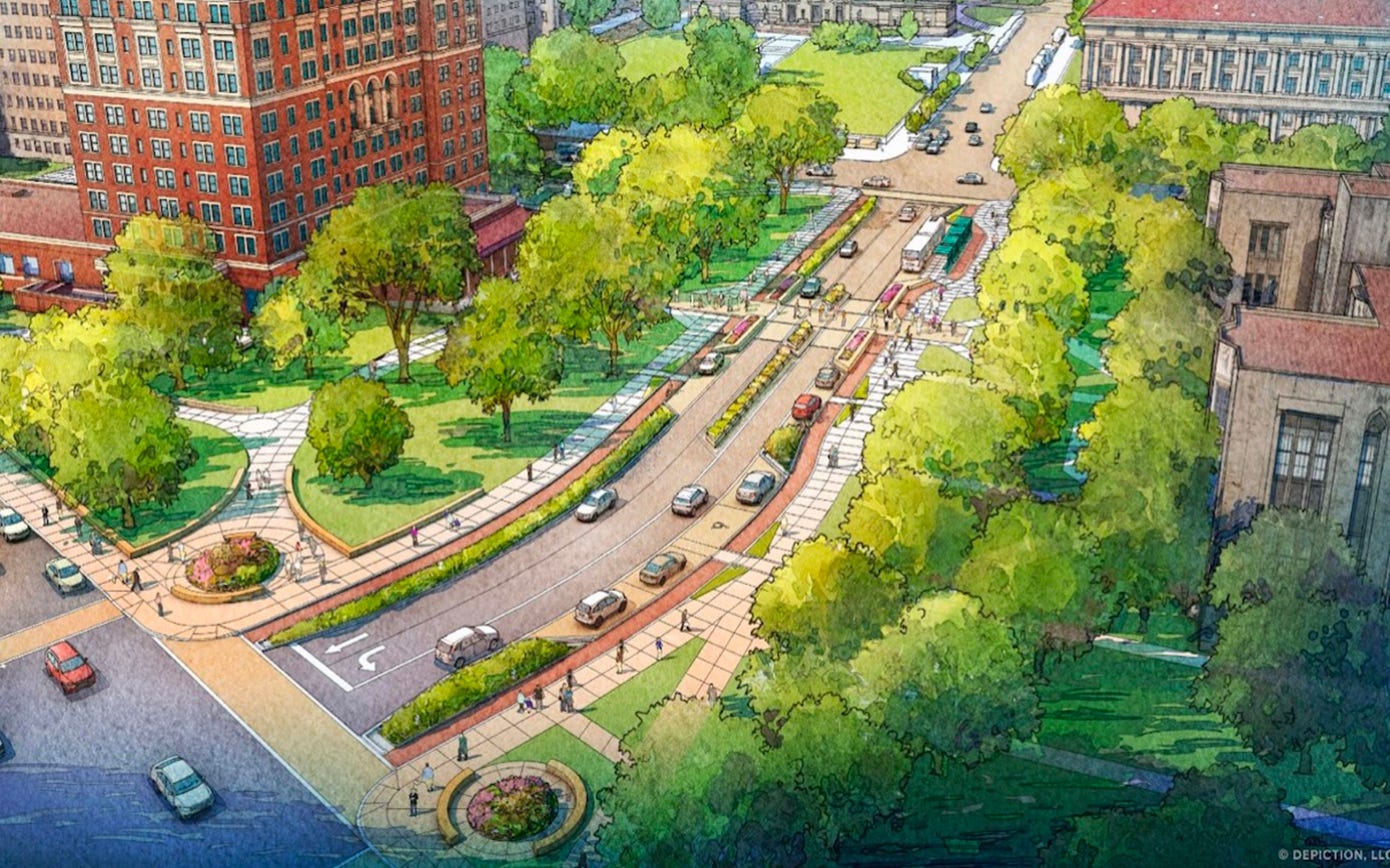
Last week, Streetfilms, a Youtube account dedicated to documenting best street design practices, posted a clip from their recent Pittsburgh video on Twitter highlighting the block of Bigelow Boulevard between Fifth and Forbes Avenues, calling it “the most complete street in the USA!” and highlighting its use of bioswales, protected bike lanes, and raised crosswalks. Possible hyperbole aside, they’re not far off the mark. Those few hundred feet of asphalt and brick are the result of a massive investment from the University of Pittsburgh, whose campus straddles the intersection. It’s a welcome improvement to one of the most high-traffic pedestrian areas in the city.
Bigelow has also been back in the news recently after a flatbed carrying a crane collided with a pedestrian bridge spanning the boulevard, causing it to be shut down and the bridge to be demolished. It’s one final humiliation in the ignoble history of Bigelow’s middle trunk, once home to four sets of city steps, a pedestrian bridge, a park and the world’s largest incline. Now only the meager park and two of the city steps remain. The steps are overgrown, guardrails askew, spitting out any who make the descent onto a 3x3’ concrete landing inches from the rushing traffic.
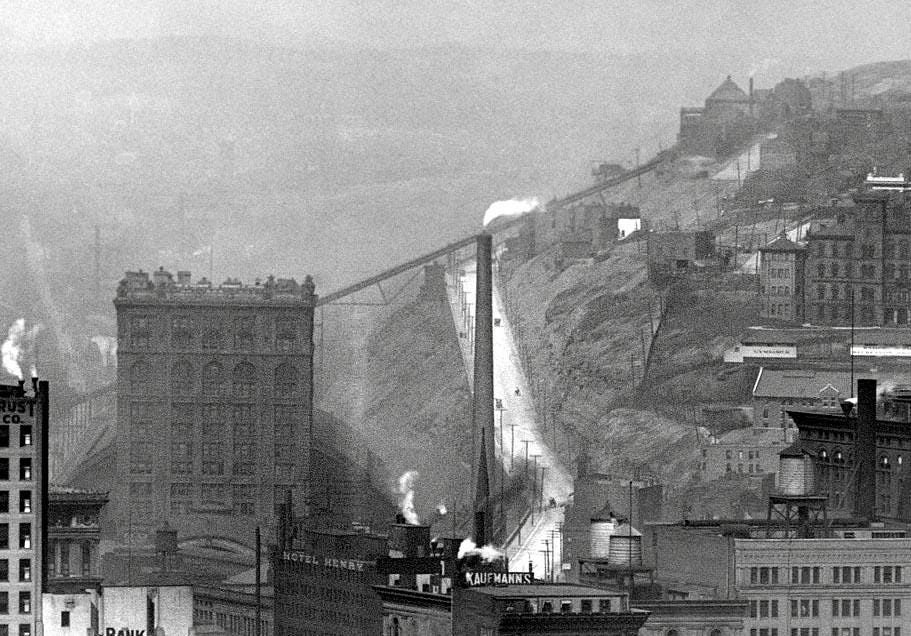
The Penn Incline, once the largest in the world, was built in 1884 to ferry Pittsburghers from The Hill to The Strip, and although it never made the profits its builders hoped it would, it remained operational for nearly 80 years. Its summit was capped by the Penn Incline Resort, a saloon and entertainment hall, and the whole grand project stood as a testament to the determination of the city’s residents to overcome the natural barriers geography had created. In a more equitable world, one where the various city administrations did not feel it was their job to corral and isolate the Black population atop the Hill, the incline would have been taken over as another form of municipal public transit. It would have been recognized as a conduit between neighborhoods that deserved to be connected, rather than bisected by Bigelow for the sake of commuter traffic.
More than anything else, Bigelow’s middle and beginning segments represent a failure of imagination, a deliberate scaling back of municipal responsibility for the cohesion of neighborhoods and populations. Transportation infrastructure is the vascular system that pumps life into a neighborhood. Which parts of the city get bus lines and construction money is a perennial hot button issue. It’s important to remember that it is still a conscious decision to allow for decay. When the city quietly tables any plans to rebuild the Finland Street pedestrian bridge, it is a deliberate choice to further sever the neighborhoods on the Hill from the rest of the city.
Even the prioritized car commuter has been cut loose by this shirking of responsibility. Where the Boulevard makes its final descent towards downtown, the arm of an on-ramp curls around the concrete skirt of the cliff face before ending abruptly in a wild tangle of trees and scrub. It’s the vestigial limb of a plan put forward by infamous urban planner Robert Moses to link Pittsburgh’s two main interstates, I-279 and 376, in a sort of demonic traffic circle. The Arterial Plan for Pittsburgh never made it beyond 200 feet of ramp. Its only purpose now is to shelter the tent of a homeless person who stays there, protected from the city government by the sheer hostility of the Bigelow environment to anyone stopping their car and going to check on him.
The construction of elevated crosswalks, bioswales and bike lanes along the Oakland corridor of Bigelow is a great thing, and the work of groups like Streetfilms to advocate for such projects is important. But while traveling from one terminus to the other, it’s important to consider what could have been along the way. If you’re able, the next time you travel that way, pull over in Frank Curto Park along the side of the cliff. Admire the french fry statue, take in the incredible view of the Strip and the North Side, imagine what it would sound like with a line of trees between you and the road to quiet the noise of traffic. Daydream of an incline that would allow you to take your coffee from La Prima Espresso in The Strip and carry it up to this beautiful view on a Saturday morning. Think about the goat-children the Pittsburgh Index observed, and try to imagine the foundations of the houses they grew up in surrounding you. Ask yourself where you’re taking Bigelow to.
Love the article. I walked across the Finland Street Bridge this past July.